
Volt Rush registration in Australia
 Available in AU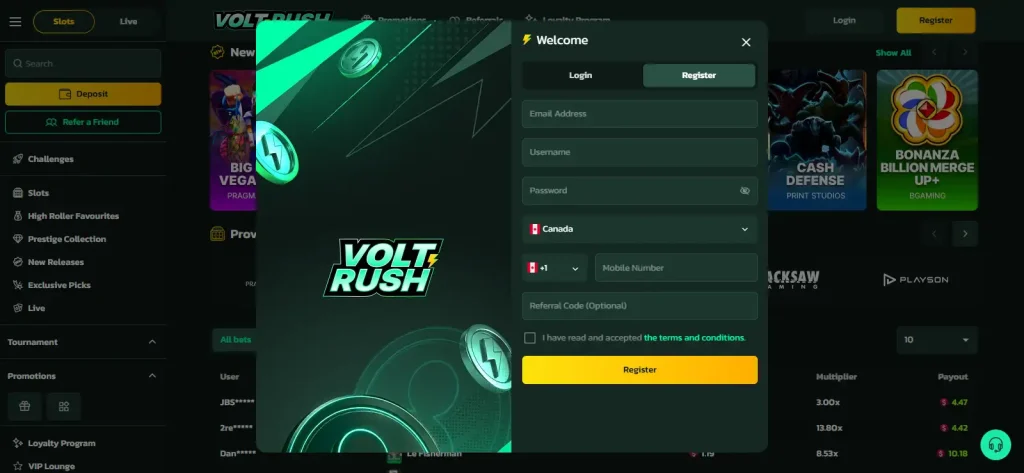
Table of Contents
- Opening the account and verifying it are separate stages
- What VoltRush asks for when you register
- The 18+ rule is an account requirement, not a marketing label
- One personal account means duplicate signups are not a workaround
- Registration does not complete KYC
- Use your own identity and your own payment sources
- The Australian-localized site does not prove Australian licensing
- A registration checklist before entering personal details
- Official references for registration requirements
- How registration details affect later account checks
- What opening a VoltRush account requires in Australia
Section element
Account setup
VoltRush requires account holders to be at least 18, create only one personal account, and register with their name, date of birth, residential address and a contact email or mobile number. Registration is the account-creation step, not the end of verification: VoltRush’s KYC policy requires identity verification by the earliest of 30 days after registration, €2,000 equivalent in total deposits, or before the first withdrawal.
VoltRush publishes an Australian-localized site, but that interface should not be treated as proof that the service is Australian licensed or lawful to provide as an online casino. ACMA states that providers must not offer online casino services to people in Australia.
Registration essentials
Opening the account and verifying it are separate stages
- Minimum age
- 18+
- Personal accounts
- One per player
- Core details
- Name, DOB, address, email or mobile
- Funds
- Must be the player’s own
- KYC
- Starts at registration, completed by set triggers
- Australian context
- Localized site does not equal local licensing
What VoltRush asks for when you register
The current AU terms say each player may create one personal account. At registration, the player must identify themselves with a name, date of birth, residential address and either a contact email address or mobile number. The terms also require the player to confirm that they are at least 18, are playing for themselves with their own money, are signing up with the casino for the first time and accept the terms.
Those requirements make the signup form more than a username-and-password step. The information becomes part of the account record used later for identity checks, payment ownership and account controls. Entering accurate residential and identity details matters because the same terms reserve consequences for false or inaccurate information.
The operator also says account details should be kept up to date. That is useful practical guidance for anyone who changes address, phone number or other registration data before a withdrawal or verification review.
The 18+ rule is an account requirement, not a marketing label
VoltRush’s terms state a minimum age of 18 and also say users must have reached any higher age required by the jurisdiction where they live. The operator can request proof of age and can restrict access or suspend an account if the requirement is not met.
For Australian readers, the useful point is that the casino’s 18+ account rule does not answer the separate question of whether the underlying online casino service may lawfully be provided in Australia. Age eligibility and provider legality are different checks. A person can satisfy an operator’s age rule while the provider still sits outside Australia’s permitted online gambling framework.
One personal account means duplicate signups are not a workaround
The AU terms permit one personal account per player and warn that multiple accounts can lead to termination and cancelled payouts. They also prohibit creating accounts for third parties and describe multiple-account creation and collusion as fraud-related conduct.
This matters if a registration attempt fails or an old account is forgotten. Creating another profile is not a clean reset. The safer approach is to recover or resolve the existing account with support rather than using a second email address or another household member’s details.
The rule also affects promotions. A second account should not be used to repeat a new-player offer. The dedicated VoltRush bonus guide covers offer mechanics separately, while this page focuses on the underlying account rule.
Registration does not complete KYC
VoltRush’s current KYC policy says verification begins when a user registers, but it is completed by the earliest of three triggers: 30 days from first registration, total deposits reaching €2,000 or currency equivalent, or before the first withdrawal. In other words, the signup form establishes the account, while the formal identity verification process can continue later.
The terms also say the operator may request additional documents to verify identity, residence or source of funds. The exact verification process belongs on the child page, so this registration guide does not duplicate every document and enhanced-check scenario. See the VoltRush KYC and verification for that detail.
Practical distinction: being able to log in after signup does not mean the account has completed every verification step required for deposits, bonuses or withdrawals.
Use your own identity and your own payment sources
The registration declarations say the player is acting for themselves and using their own money. The payment terms reinforce this by prohibiting third-party payments and requiring deposits from payment methods registered in the player’s own name.
This creates a consistent account trail. The name and residential details entered at signup should align with later identity evidence and with payment ownership. Using another person’s card or creating an account in another person’s name can create both verification and payout problems.
For users who plan ahead, the account setup sequence is therefore straightforward: register with accurate personal details, use payment methods in the same identity, and complete requested verification before relying on a withdrawal.
The Australian-localized site does not prove Australian licensing
VoltRush currently publishes Australia-localized pages under an /en-AU/ path and supports AUD. Those are observable localization choices, but they are not evidence of an Australian gambling licence. ACMA’s current guidance says the Interactive Gambling Act 2001 makes it illegal for gambling providers to offer some online services to people in Australia, with online casinos listed among the banned services.
That distinction matters on a registration page because a visible signup button can look like an availability signal. Technically, it shows that the website presents an account-creation interface. It does not establish that the online casino service is authorised under Australian law.
For the legal framework, enforcement context and the difference between offshore licensing and Australian authorisation, read the Australian online casino rules. This account page stays focused on what the operator requires from the user.
A registration checklist before entering personal details
- Confirm that you meet the operator’s 18+ age requirement.
- Use your legal name, correct date of birth and current residential address.
- Provide an email address or mobile number you control and can continue to access.
- Do not create a second account if you already registered previously.
- Expect KYC to continue after signup and to be completed by the applicable verification trigger.
- Use payment methods held in your own name if you later fund the account.
- Do not treat an Australian-localized signup page as evidence of Australian licensing or provider legality.
The VoltRush Australia review connects these account requirements with payment restrictions, game access, bonuses and licensing context.
Official references for registration requirements
The current VoltRush AU Terms and Conditions set out the age, personal-detail and one-account requirements described here. The current VoltRush KYC policy sets the verification timing described here. ACMA guidance provides the Australian legal context; the presence of an Australian-localized website does not establish local authorisation.
How registration details affect later account checks
The information entered at signup becomes the reference point for later account checks. A legal name, date of birth, residential address and contact detail are not isolated form fields: they are the details the operator can compare with identity documents, proof of address and payment ownership when verification is required. That makes accuracy at registration materially useful. Correcting a typo is different from opening a second profile, and the one-account rule means a duplicate account is not a sensible way to solve an access or data problem.
The same logic applies to payments. The terms require the player to act for themselves and use their own money, while the payment rules prohibit third-party funding. Keeping the account name and payment ownership aligned reduces the chance that a later withdrawal is complicated by an identity mismatch. It also makes the distinction between registration and KYC easier to understand: the signup stage records the account details, while KYC later checks evidence supporting those details by the first applicable trigger.
A practical sequence is therefore to create one account with accurate information, keep those details current if something changes, use payment methods held in the same identity, and treat verification as a normal account requirement rather than a surprise attached only to withdrawals. This does not change the separate Australian regulatory position. It simply explains how the operator’s own account rules connect the signup form, payment ownership and later verification into one continuous account record.
Before funding the account, it is also sensible to confirm that the registered email address or mobile number remains accessible for account notices and verification requests.
What opening a VoltRush account requires in Australia
VoltRush signup requires an adult user to create one personal account with accurate identity, residential and contact details and to act with their own funds. That creates the account but does not finish every compliance step: KYC begins at registration and must be completed by the applicable time, deposit or first-withdrawal trigger. For Australian readers, the most important distinction is external to the form itself. A localized registration interface is a website feature, not proof of an Australian licence or permission to provide online casino services in Australia.